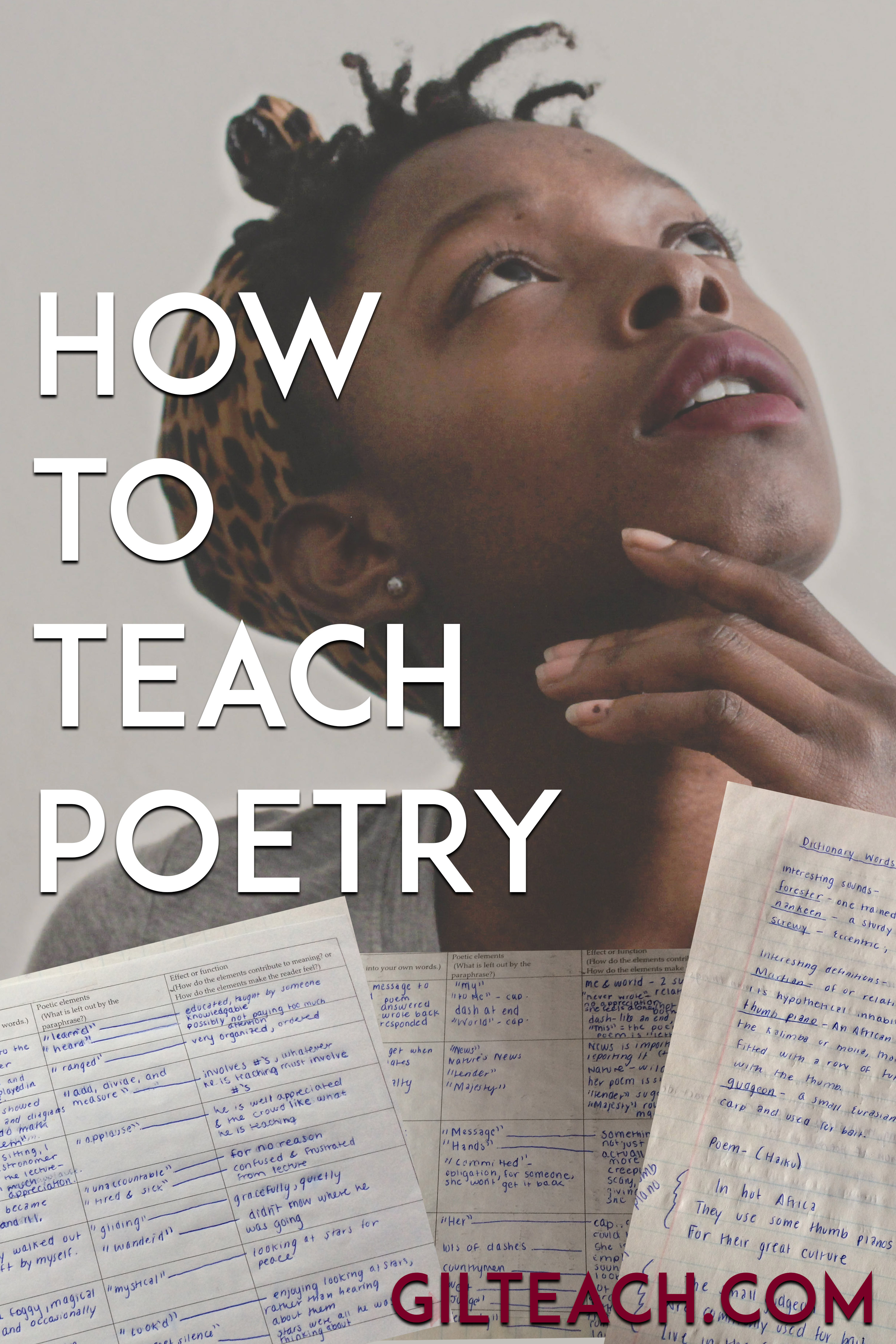
How To Teach Poetry

How To Teach Poetry April is National Poetry Month, and while I could happily spend hours analyzing a poem with a group of seventeen-year-olds, I know that not everyone feels that way. Poetry is not always an easy sell.  Students might not have much experience with poetry, or they don’t like it, or they think that it’s going to be too hard.  But by the end of my introductory unit, I have won (almost) all of them over.  They look

Read more
Argument Essay Unit: Cellphone Pros and Cons

I have to admit that I resisted teaching a research based argument essay in my ELA classes for over twelve years.  Each year, I would “forget” or “not get to it” or “sort of do an assignment that fulfills the requirement.”  The requirement, as I understood it, was for students to click around on the internet for a few hours, put some facts together in a new format, and then say where they had gotten that information.  It seemed like

Read more

14 Questions for Examining Mentor Texts (Of Any Kind)

Once students are comfortable reading and analyzing mentor texts in order to improve their own writing, it’s nice to be able to let them work through a text independently.  Still, they might appreciate some scaffolding or reminders of what to look for.  These fourteen questions will work for just about any kind of writing—from cutting edge journalism to revealing personal essays to experimental poetry.    For a printable version of this handout that you can use tomorrow as well as

Read more

5 Ideas For Fun And Meaningful Creative Writing In The Secondary Classroom

At the beginning of the school year when I let students ask me anything they wanted, I invariably got the question “Will we be doing any creative writing in this class?”  Usually, the kid who asked the question felt that they had not been given enough opportunities for creative writing in their other English classes.  I think that many teachers have good intentions to give their students opportunities to be creative and experiment with different forms, but after all of

Read more

How To Teach Writing: My Top Ten List

I’ve recently created a resource that combines all of my writing lesson plans—prompts, creative assignments, units on persuasive essays and personal essays and some just weird fun stuff that I think is pretty innovative. So I have been thinking a little about my philosophies on teaching writing. I remember early on in my career as a teacher, when I realized that I was doing fine with the literature and books, but that I was really lagging behind with the writing

Read more

Poem of the Week: American Dreams, Struggle, and Unity

I don’t think that I will ever be able to hear the words “great” and “America” together again without cringing.  And yet, I want to continue the discussion about how we can all achieve the American Dream. I guess that what I most want my students to understand about the place they live is this:  It’s complicated.  It’s not really about whether America was or ever will be great—it’s about looking at what does work and looking even more closely

Read more

6 Tips for Teaching Fake News: Digital Literacy Do’s and Don’ts 

If you have students over the age of 16, they’ll be eligible to vote in the next presidential election.  Will they have the information to make the best decisions for themselves and their country?  If they’re making their choices based on fake news—or misinformation and disinformation—the consequences of those choices could hurt us all. You know that you need to teach your students to be more savvy consumers of digital information who are equipped with the correct tools for evaluating

Read more

Classroom Management: Why I Love a Good Jigsaw

Students moving around the room, talking to each other, sharing information, and teaching their peers—it’s sort of a teacher’s dream, and it’s what happens when I do a jigsaw activity with my students. I use a jigsaw in three of my content-heavy resources: my Fake News and Digital Literacy Unit, my Growth Mindset Unit, and my Elements of Poetry Unit. The basic idea of a jigsaw is that students learn a piece of the content and then teach that to

Read more

Common Core: 3 Tips for Teaching With Challenging Non-Fiction

Whether I’m assigning an article about the relationship between a fixed mindset and the Enron scandal or I’m requiring students to read an essay about how basketball, race, and dreams are all intertwined, I have a few common goals when I choose challenging non-fiction to incorporate in my lesson plans. I want students to learn how to deal with difficult vocabulary, how to navigate complex sentence structure sentence structure, and most importantly, I want them to learn how to question

Read more

Classroom Management: Why We Freewrite

It’s kind of funny that as a teacher I can relearn the same lessons over and over again—I’ll forget how affective a strategy is or how crucial one step is—until I am brutally reminded when a lesson falls flat or an assignment turns out terribly.  One of the lessons that I learn over and over is how important the freewrite is. Last year I was grading the midterm exams from my junior honors American Literature class, and there was one message that

Read more
1 2 3 4 5