Annabel Lee Lesson Plan Ideas: Teaching Poe’s Classic, Creepy Poem in Context
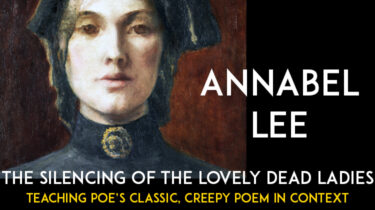
Edgar Allan Poe once said, “The death, then, of a beautiful woman is, unquestionably, the most poetical topic in the world.”
And his famous poem “Annabel Lee,” which is widely taught in schools, is often seen as a lovely though slightly creepy portrayal of idealized love.
However, when read with more context, his version of the beautiful dead woman is both more troubling and more meaningful.
My goal for a complete unit on “Annabel Lee,” is for students to appreciate the artistry of a classic poem and to learn how to read, enjoy, and analyze poetry. More importantly, though, I want them to question why someone would think a woman was more beautiful when dead, and to wonder why the ideal woman so often seems to be one who can’t talk back.
Here are my 6 tips for teaching a unit on this creepy and questionable classic poem with activities and discussion ideas to get students thinking.
Start off with a visual art opener.
Having students analyze visual art is a nice way to both build their critical thinking skills and change things up a bit. As a famous portrayal of another beautiful dead woman, the painting Ophelia by John Everett Millais is a good way to jump start your unit on “Annabel Lee.” After a few quick discussion questions that get students noticing how the painting portrays the subject, students are ready to go deeper in their analysis.
Read “Annabel Lee” in the context of two other poems about lovely, silent ladies.
I like to pair Poe’s story of romance in the tomb with “He Wishes His Beloved Were Dead” by William Butler Yeats and “In an Artist’s Studio” by Christina Rossetti. Interestingly, the model for Ophelia, Elizabeth Siddall, later married Dante Gabriel Rossetti, brother to Christina Rossetti and likely the artist criticized in her poem “In an Artist’s Studio.”
Both of these poems add more depth and complexity to a study of “Annabel Lee.” Yeats’ poem is less about a desire to literally have a dead lover and more about his desire for his beloved to change—he seems to be aware that his desire for a pliant partner is not very realistic since she would have to be dead to fulfill his desire. Rossetti’s poem calls out those male artists who portray not real women but oversimplified, fantasy versions of them “not as she is, but as she fills his dream.”
When read in the context of these other poems, Poe’s portrayal of a woman who was beautiful, innocent, pure, and lived to love her man becomes less romantic, more problematic—and also part of a bigger pattern.
Give close reading questions that get students examining how poetic elements function to create meaning.
I’m generally more of an ideas person, and so I often gravitate towards examining the themes in literature. But what makes those three poems, well, poetry, is the way that they are written, and so I think it’s important to slow down and unpack the language and poetic elements. For example, one activity in my unit asks students to list all of the words that the speaker in “Annabel Lee” uses to describe his love. What they notice is that we learn very little about her personality beyond her beauty, and in fact, in his descriptions of her, the words “my” and “beautiful” are repeated the most, suggesting that his possession of her physical attractiveness is what is most important to him. Similarly, beyond just having students identify the poetic elements of repetition, alliteration, and rhyme in “Annabel Lee,” I have them think about the effect those choices have on them as they read the poem—and how the calm, soothing tone of the poem contrasts so sharply with the disturbing subject matter.
Work in low-key poetry writing activities throughout the unit.
To get students thinking about how poetic elements function from the inside out, I like to work in some poetry writing exercises at the beginning and end of class whenever there is a little time. When students play with elements like figurative language or diction, they start to see how a poet’s choices help to form the experience of the poem. This also shows them that poetry writing doesn’t have to be scary and gives them something to work off of when they write an original poem for their final assignment.
My favorite poetry writing exercise that gets students really paying attention to word choice in poems is to have them write found poems or black-out poems. Another low-stakes-high-results exercise is to have students write imitations of poems by taking words and phrases from the original and then substituting their own topics. So they might write something like “It was many and many weeks ago, / In a classroom by the sea, / That a test was given on a topic you may know / By the name of geometry.” This results in some silly poems but it’s also a great way to get students paying attention to structure and line breaks and works really well with over-the-top poems like “Annabel Lee.”
Examine more visual art.
Next, I suggest having students come back to analyze more visual art of the period, this time looking at three paintings by Christina Rossetti’s brother, Dante Gabriel Rossetti. Examining passages from Rossetti’s poem like “One face looks out from all his canvases / One selfsame figure sits or walks or leans…” or “she with true kind eyes looks back on him,” students can look for those elements in the paintings and give specific examples of where they find them or point out where they think the poem’s criticism doesn’t apply. Again, these visual art activities broaden the discussion and also deepen students’ analysis and understanding of the big ideas.
Give the women a voice to write back.
As a final assignment for this unit, I like to have students write an original poem in which one of the women portrayed by the male artists gets a chance to write back her side of the story. Since students need to base these poems on evidence from the three poems they read in class, it’s a rigorous assignment that tasks them with showing insight into the themes of the sources.
It also gets them creating their own poems in which they need to incorporate the poetic elements they’ve been both studying and practicing. For example, a student writing as Annabel Lee might repeat a word or phrase from the original poem but give it a very different meaning, or they might decide to use alliteration but make it more jarring and less soothing.
But what I really love about this assignment is that when students follow the steps and just put the pieces together they honestly come up with some pretty great final products.
Want to teach a lesson plan on ”Annabel Lee” that includes all of these elements plus complete answer keys? Check out my complete unit here.