American Lit. Curriculum: What I Always Wanted to Teach
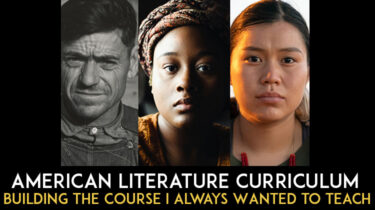
I have always loved American Literature. It’s just so fresh, exciting, and inspiring—from Gothic horror to contemporary Native poetry, from immigration stories to feminist sonnets, from jazz-inspired poetry to accounts of the witch trials.
Yet the more time you spend reading American literature, the more you realize that so much of our greatest writing comes from moments we’d rather forget. It’s a relatively short history, but it’s one full of injustice, cruelty, and just plain shameful acts.
So how do you teach students the truth about America’s past without leaving them cynical about its future? And how do you do that while helping them fall in love with the literature itself?
The main problem with creating an American literature curriculum isn’t what order to teach the texts. The real problem is that every American literature curriculum tells a story about America.
Whether we intend to or not, the literature we choose, the history we emphasize, and the questions we ask all shape the way our students define the American experience. So how do we give students a balanced yet realistic—and enjoyable—introduction to American Literature?
After years of reading, researching, and following rabbit holes, I realized the story I wanted my American Literature curriculum to tell. Yes, it’s the story of a country with some really awful history—full of abuses of power, injustice, and just plain cruel actions. But it’s also the story of incredible groups and individuals who resisted, fought back, and created extraordinary art in the process.
So what does that actually look like over the course of a school year?
This is how I organize my Full-Year American Literature Curriculum.
Unit 1: Who “Sings” America?
Knowing how much challenging work would come later, I wanted to start the year with a low-key unit that could ease everyone back in while also inviting students to start asking big questions about how we define America and whose voices have been included and excluded from that discussion. Rather than focusing on answers to these big questions, this first unit serves as a way of opening the discussion and connecting to more literature throughout the year. The poetry of Walt Whitman, Langston Hughes, and Allison Adelle Hedge Coke gives students multiple views on the essential questions, and a compelling TED Talk by Amanda Gorman gets students thinking about power, voice, and literature.
Unit 2: Personal Essay
While I have many goals around teaching history and great literature, getting in apersonal essay unit as early in the year as possible is also really essential. Knowing that we are going to be on this journey of exploring challenging literature and history together throughout the year, I think it’s important to connect with them as soon as possible. Students also carry the writing lessons throughout the year, and it’s useful to establish the writing workshop routines early on in the year.
Unit 3: The Crucible
The first big text of the year is The Crucible, and I have really loved teaching this play with my students of all levels. It gets at so many great questions around power, gender, and dissent while also just being a compelling story. It’s the first point in the year where students start to really dig into questions around how bad things happen—and what it takes to avoid the mistakes of our shared past.
Unit 4: Thematic Unit on the Salem Witch Trials
So many of our values and practices as a nation were founded on the Puritan times that I really think it’s essential for students to get some experience with primary sources—specifically Anne Bradstreet and Cotton Mather. But I also take advantage of teaching the topic thematically and so I include “Half-Hanged Mary” by Margaret Atwood. Telling the true story of a woman who was hanged for a witch but survived, this modern poem also more explicitly draws attention to issues of gender and power that are more subtly suggested in the older texts.
Unit 5: Media Bias & Digital Media Literacy Unit: Reliable, Credible Sources v Fake News
Speaking of units that I try to teach as early in the year as possible—and that students come back to again and again throughout the year—the next unit that I include is a unit on fake news and digital media literacy. The lessons in this unit walk students through an introduction to cognitive bias, identifying what they know, understanding the impact of fake news, looking at the way that quality journalism is constructed, and learning how to be responsible consumers of media. It’s also fun to teach this unit right after reading The Crucible—asit turns out, lack of critical thinking wasn’t limited to 17th-century Salem.
Unit 6: Thematic Unit on the Trail of Tears
I’ve found so much great Native literature in my work on developing American lit. units over the years, and a hill that I will die on every single time is that teaching Native literature as a kind of “pre” American literature—focusing, in other words, on trickster tales and creation myths and leaving it at that—gives students the message that Native literature and culture is dead and gone. I won’t do it and I hope you won’t either.
This unit was one of the first that I developed to thread the fine line between examining the injustices of the past and considering why, as Faulkner once so famously said, “The past is never dead. It’s not even past.” When I found Linda Hogan’s prose writing on the removal and her poem “The Trail of Tears: Our Removal,” I knew that I had found the heart of this unit. Hogan manages to highlight the brutality without sensationalizing it. I also knew that students might have already read plenty of dry history articles on the Trail of Tears (or maybe they knew nothing) so I found two short videos to give them enough context to start digging into the deeper questions on why treaties still matter and why these issues of the past are very much not in the past.
Unit 7: Introduction to Poetry Analysis with Walt Whitman and Emily Dickinson
My number one goal in teaching students to analyze poetry is to give them the confidence and skills to read, enjoy, and understand poetry on their own. This is not an easy task! But I have found that the graphic organizer method that I use in this unit—in which students first paraphrase a line or sentence from the poem, then notice what literary elements are left out of their paraphrase, and then examine both the meaning and the effect on the reader that is created by those elements—really challenges and supports them to actually analyze a poem. This unit starts off with students learning/reviewing poetic elements, and then we practice analyzing poetry together, in pairs, and independently. To me, teaching students to analyze poetry is a great way to build the critical thinking and evidence-based reasoning that they need.
Unit 8: Short Story Unit
For the short story unit, I decided to focus on reading stories in context. This means that besides just reading some of the most fabulous works of Poe, Faulkner, Jackson, and Hurston, students are also learning about alcoholism in the 19th century when they read “The Black Cat” and about the Southern Tenant Farmers Union when they read “Barn Burning.” The honors class reads those same great stories plus more, including “The Yellow Wallpaper.” Besides reading some truly excellent stories, this unit gets students to grapple with questions like What does it mean to “do the right thing”? and Why do people make harmful decisions even when they know better?
Unit 9: Thematic Unit on the Dakota 38
This unit does not cover material typically found in most American literature classrooms, and yet the moment I read Layli Long Soldier’s incredible contemporary poem about the Dakota 38, I knew I needed to develop a unit around the events that led to the largest execution in U.S. history. Again, though, I didn’t only want students to be confronted with an awful event from the past, I ideally wanted to equip them with the critical thinking skills to avoid similar events in the future. So I built around the poem with an engaging radio show, primary source documents, visual art analysis, and a powerful documentary to give students context and to get them really thinking deeply about the past, memorial, and how the way we tell our shared stories helps to create our current version of the truth.
Unit 10: Thematic Unit on the Harlem Renaissance
If you’ve ever fallen down a Harlem Renaissance rabbit hole, you know exactly what happened when I started working on this unit. The more I read, the more I wanted to include. And the more I wanted to include, the more I realized that I couldn’t just make a long list of required texts and leave it at that. Students needed to understand not just the individual works, but the historical context and artistic ideas of the time. So they study not just the typical poems by Langston Hughes and Claude McKay (though they do read those!) but they also examine a photographic essay, a satirical essay, poetry, and lots of music. By the end of the unit, students understand the Harlem Renaissance not simply as a collection of famous poems and stories, but as a vibrant conversation filled with competing ideas, artistic experimentation, and enduring questions about race, identity, and the purpose of art.
Unit 11: Thematic Unit on Boarding Schools and Native American Assimilation
When I first started working on this unit, I was faced with, yet again, a horrific chapter in our history. And so rather than just focusing on all the awful things that happened when the United States forced tens of thousands of Native American children from their families and into boarding schools designed to erase their languages, cultures, and identities, I also decided to highlight how those children resisted their oppressors. A poem by Louise Erdrich, a fascinating painting, real-life stories from survivors, and a mini documentary on a contemporary skate-boarder make this unit about the past, but also about survival, art, and resistance.
Unit 12: The Great Gatsby
I’ve loved Gatsby since I first read it myself in high school, and yet, when I set out to create curriculum on it, I knew that I would have to walk the line between helping students appreciate Fitzgerald’s gorgeous prose while also challenging them to think critically about the novel’s assumptions and blind spots. So when I developed this unit, I made sure to focus on more than just the plot. Alongside close reading and discussion, students explore the historical realities of the 1920s—from Prohibition and gender roles to white supremacy and class—to better understand both the world Fitzgerald was writing about and the one he left out. I’ve found that this combination helps students appreciate the novel as a literary masterpiece while also seeing why it continues to spark important conversations today.
Unit 13: Thematic Unit on the American Dream
This is one of the rare units that I did actually develop while I was still in the classroom. Though the version I taught then was way less developed than what I was able to create when I stopped teaching, it did give me a sense of the magic that I could create when I brought together diverse sources to examine essential questions. This unit includes the film Hoop Dreams, which is both heart-wrenching and a masterpiece of documentary filmmaking. It also includes poetry by Langston Hughes, “Two Kinds” by Amy Tan, and a fascinating essay about a man who successfully lied his way into Princeton.
Unit 14: Thematic Unit on the Contemporary Immigration Experience
My goals in creating this unit can be summed up in one word: empathy. Even though they might know that opening the “golden door” for those “huddled masses yearning to breathe free” is a foundational value of this country, many students don’t have first-hand experience with immigration. And so as I chose texts and sources to make up the unit, I decided to focus on contemporary stories of immigrants. Again, I realized that including photographs, radio shows, interviews and essays along with poetry and short stories was the best way to make the unit both relevant and rigorous. This unit won’t change government policy or organize a protest at the border, but the contemporary real-life stories, struggles, and triumphs will inspire students who will soon be out in the world on their own and voting for the ideas that matter most to them.
Unit 15: Thematic Unit on the Native American Storytelling
After a year of building their skills and examining lots of tough topics, I wanted to end the year on a lighter note with a reminder of why stories and literature truly matter—and as a final chance to get in more of the amazing Native literature that I had discovered in my work developing the curriculum. Talk about texts and sources I wish I had discovered while I was still teaching! Whether it’s Jimmy Santiago Baca’s amazing essay on how he was saved in prison through literature or Stephen Graham Jones’ masterfully terrifying short story “Raphael” or the hilarious, sad, lovely film Smoke Signals, this unit includes some truly compelling, accessible, and great American lit.
I hope this post gives you some ideas on ways to teach American Literature that recognize the past, teach students to think critically about their country, and also show them how much fabulous literature there is to enjoy.
If this approach to teaching American Literature sounds like the kind of curriculum you would create if you only had the time, I’ve already spent years reading, revising, researching, and asking, “Would my students actually care about this?”
The result is a complete curriculum—including two differentiated pacing guides, daily lesson plans, close reading and discussion questions, writing assignments, assessments, and carefully curated supplementary texts—so you don’t have to spend years chasing down the same rabbit holes I did. You can learn more about the Full-Year American Literature Curriculum here.