Teaching “The Lottery” by Shirley Jackson: Meaningful Discussion Questions and Lesson Plan Ideas
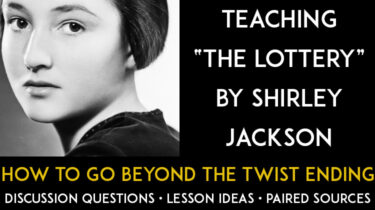
When Shirley Jackson first published “The Lottery,” her mother told her in a letter, “This gloomy kind of story is what all you young people think about these days.”
It’s been seventy-eight years since that letter, and given the world they have inherited, young people are still thinking about gloomy stories.
Yet it’s easy to teach this classic story as nothing more than a shocking twist ending set safely in the past.
Whether we like it or not, the question “Would you speak up against injustice?” is no longer theoretical.
When I teach a complete unit on “The Lottery” by Shirley Jackson, I don’t want my students to walk away thinking, “I can’t believe those people were so awful.” I want a lesson plan that helps them see how the story challenges them to be the one who refuses to throw the stone in their own lives.
Here are my 8 tips for giving this gloomy, challenging, masterful story its due.
Start with a cold reading. I prefer to just read the story out loud in class as students read along—no anticipation, no pre-reading, no introduction—so that the full shock and weight of the ending can hit them. Once they realize how much of an impact the surprise ending has on them, we can take that response and go deeper.
Use freewrite prompts to get students thinking about how the essential questions apply to their own lives. I like to get students writing in the first few minutes of class on questions like “When people idealize simpler times of the past, what are some things they are disliking about the present?” or “Write about a time when you wanted to speak out against injustice but didn’t because you were afraid.” These questions help students to extend the conversation and start to think about how they might apply some of the learnings to their own lives.
Get students thinking about the literary elements from the inside out with creative writing exercises. In my experience, students can identify setting or characterization all day long, but getting them really thinking about why authors choose to convey their messages in different ways or how a setting description might affect a reader’s experience is a lot harder. But when students try their hand at writing their own setting, dialogue, and characterization with purpose they start to see much more clearly how those elements work in fiction. For all of these exercises, I incorporate a guessing game that shows students how much they can show with their choices. It’s fun and low-key, but really helps in advancing students’ understanding.
Focus close reading questions on the impact of Jackson’s choices. Because this story has such a strong impact on a reader—how can you not get chills when you figure out what’s happening?— it’s an especially great choice for getting students to really unpack the effect of different choices the author made. The tone established in the first paragraph of the story, or the detail that even Davy Hutchinson is “given a few pebbles,” or the fact that the black box is shabby, splintered, faded, and stained all contribute to that impact.
However, you need the right kind of scaffolded discussion questions on “The Lottery” to get students analyzing on this story higher level. Nothing kills a class discussion faster than questions like “what does the black box symbolize”? Instead, I get students comparing Jackson’s choices to other choices she could have made. Getting students to think about how their experience as well as the meaning of the story would change if it had been a gloomy day or the townspeople used a shiny new box, or if they had left Davy Hutchinson out of the stoning really help them to understand why Jackson does what she does.
Teach the story with historical context of the Nuremberg Trials. Shirley Jackson published “The Lottery” in the June 26, 1948 issue of The New Yorker. World War II had ended a few years earlier, and the Nuremberg trials were still going on in Germany. Jackson’s message that horrific violence can be committed by even the most normal human being was shocking to her readers, but the genocide of a few years earlier had certainly proven that to be true. Getting students to read the story in that real-life context helps to drive home the relevancy and urgency of the tale.
Help students understand how just going along to get along is dangerous in any time. In his famous experiments on the “following orders” defense, Stanley Milgram proved that a high proportion of the men studied (he didn’t experiment with women) will follow orders to hurt and potentially kill another human being even though those orders go against their personal morals. Stanley Milgrim wouldn’t conduct his first obedience study until 1961, but they are quite relevant to Jackson’s view of human nature. I also like to pair this story with Barbara Coloroso’s TED Talk “From School Yard Bullying to Genocide.” Giving your students this additional context of the story is a great way to help them understand that unless we are actively resisting injustice, we are probably helping to continue it.
Get students thinking about who “they came for” in their own lives. I also pair this story with the famous poem “First They Came” by Pastor Martin Niemoller. While this poem is simple and straightforward, having students write their own imitation of the poem about marginalized or victimized groups in our society really brings their understanding to the next level.
Give a meaningful assessment. Sure, a multiple choice quiz that asks students if the box is black, gray, or blue might seem easy, but if we’re really trying to foster a generation of independent thinkers who would speak out against the lottery, it’s more important to help them develop their voice than it is to help them develop their multiple choice skills. So I like to end my unit on “The Lottery” with a student-lead graded discussion in which I play no role but to listen.
Shirley Jackson’s gloomy story deserves more than a quick gasp and a quiz.
Want to teach a complete lesson plan on ”The Lottery” that includes all of these elements plus complete answer keys? Check out my complete unit here.